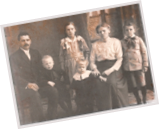

Kornelius/Amalie
.< go to Amalie's ancestors
.< go to Kornelius' ancestors
.
Johan Kornelius Fjeldskaar
02.08.1884 – 29.02.1948


«Our life time consists of short moments, so we have no time to criticize each other«
(preacher Johan Kornelius Fjeldskaar; quoted by Paulus Barth Nielsen)


Baptism and confirmation certificate for Kornelius (left); the farm Fjeldskår anno June 2006 (right). The farm was owned by Johan Enok (Johan Kornelius's father), and was taken over by Johan Kornelius' half-brother Gerhard. Here is an excerpt from the inheritance settlement after Gerhard.
Johan Kornelius was the son of Karen Gurine and Johan Enok, and was born 2/8-1884 in Flatebø in Spangereid. The story goes that he was called "the guy with the hair"; he had dark hair, and had nice curls. This is visible on some photos below.

Fra Family Search (bilde fra Fjeldskaar.com)
I løpet av Johan Kornelius’ liv, var det flere verdensomspennende kriser, bl.a. to verdenskriger, en influensa-pandemi og en økonomisk depresjon. Disse globale vanskelige periodene har selvsagt også også påvirket Johan Kornelius’ liv – i ulik grad. Influensapandemien kalles også spanskesyken. Den hadde svært høy dødelighet og smittet anslagsvis 500 millioner mennesker – rundt en fjerdedel av verdens befolkning. Antallet døde er anslått til mellom 17 og 50 millioner, og kanskje så høyt som 100 millioner, noe som gjør den til en av de verste pandemier i historien. Det antas at det i Norge omkom 13 000–15 000 mennesker, de fleste av lungebetennelse eller lungekomplikasjoner.
.
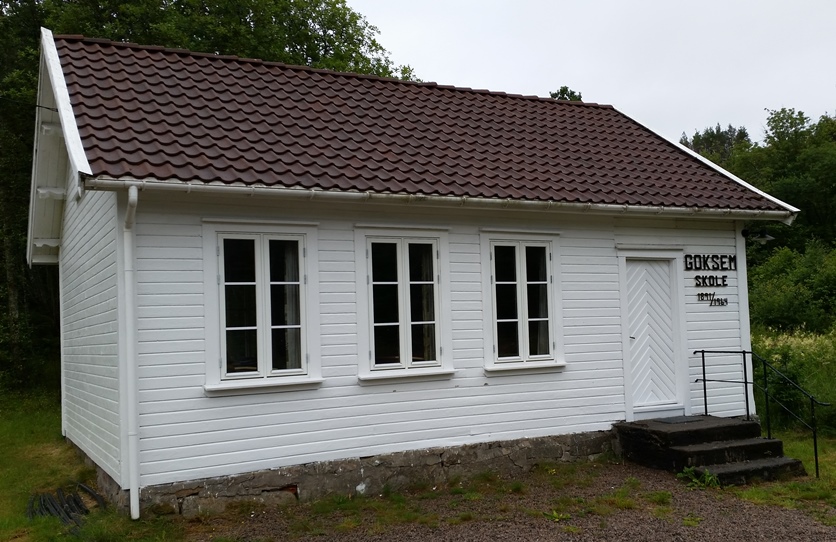
Goksem (Gauksum) is from old days a farm located in Lindesnes municipality in Vest-Agder county, between Ramsland and Fjeldskår. It was until 1964 the place for the elementary school for residents of Lindesnes. In 1964 the school was closed down and the school moved to Spangereid. The school-house in the photo was built in 1891. Both Johan Kornelius and Amalie went to this school (see school protocol further down).

Johan Kornelius (click to see larger image)
Johan Kornelius was born on Flatebø, but moved (a couple of km) with his family to Fjeldskaar ca 1890. When they moved to Fjeldskaar, Johan Kornelius 6 years. Two years after they moved, when Kornelius was 8, Johan Enok married Teodine Emilie Tørresdatter (from Jørgenstad). It is not unlikely that she (before they married) had been a maid at the Johan Enoch when he was a widower with two small kids. When they got married, the family relations became a little intricate because Teodine was cousin with Tomine (mother of Amalie).
Johan Enok and Teodine had four children, who then were Kornelius' half-siblings. It must have been crowded in the little house on Fjeldskaar – Johan Enok with his kids Johan Kornelius and Sofie from the first marriage and his 2nd wife Teodine with the kids Edvarda, Sigurd, Gerhard and Marie.

Click to see a bigger picture
Johan Kornelius ble konfirmert i 1898. Han er ikke registrert på Fjeldskaar under folketellingen i 1900, så da hadde han nok flyttet hjemmefra. Men hvor ble han av? Den eneste som er å finne i Folketellingen på Sørlandet i 1900 som heter Johan Kornelius (eller bare Kornelius, eller bare Enoksen, evt Fjeldskaar), og kan tenkes å være Johan Kornelius Villumsen Fjeldskaar, er bosatt i Farsund og registrert under navnet Johan Kornelius Wilhelmsen, født i Søndre Undal i 1884. Det stemmer iallfall «vår» Johan Kornelius var født i Søndre Undal i 1884. Det kan tenkes at navnet er skrevet feil, og at det skulle være Villumsen, som jo var faren sitt etternavn. Hvis dette er farfar Johan Kornelius, så var han altså «snedkerlærling» i Farsund år 1900.

Kornelius' sister, Sofie, used the surname Villumsen when she married, which strengthens the assumption that "carpenter apprentice" Johan Kornelius Wilhelmsen in the census in Farsund was a typo for Johan Kornelius Villumsen from Fjeldskaar.

What was featuring Farsund in Kornelius' youth? Farsund has been a significant maritime city. Already in 1795 the city received the status as a 'ladested', and the city was built on the export of lobster and lumber. In 1837 115 vessels with 470 man crew were residing in the city. In 1914 little Farsund had almost 1500 inhabitants fifth among Norway's maritime cities. In the early 1900s, there were several shipping companies which saw the light of day in Farsund.


Passenger document for Kornelius' USA-travel in 1925, which shows that he first traveled to the United States in 1905.
.

Kornelius and Amalie married in New York City 10. July 1906

Kornelius and Amalie travelled the first time to the United States in 1905 and 30. January 1906, respectively. Half a year later they got married in New York City. She joined Kornelius on some of his later travels to the US. On one of his journeys, Ruth was born (1907); on another journey (1911) William was born. Both Ruth and William was later with him to the US. William was in the US for 5 years from the time he was 15 years old. Ruth stayed in the US. They got additional two boys, Einar and Arnfinn.
Johan Kornelius also worked as a carpenter in Norway, but probably not particularly remunerative. He did a lot of volunteer work, and there are not few pulpits around the country, which he has built. It wasn't rare that he, on his preacher travels, "paid" for the hospitality (accommodation and meals) with his carpentry, and made small furniture.
Hvor var haugianerne?

Historikeren Karsten Alnæs har sagt at det er to personer som i stor grad har forandret Norge – Olav den Hellige og Hans Nielsen Hauge. Mange er sikkert uenig i det, men det viser at Hans Nielsen Hauge var en betydelig person for utviklingen til dagens Norge. De fleste forbinder Hans Nielsen Hauge med åndelig vekkelse. Og det er ikke feil; han ble opphavsmann til den mest omfattende religiøse fornyelse noensinne.
Men Hans Nielsen Hauge var ikke bare lekpredikant, han bygde et gründernettverk som sto for etableringen av en lang rekke virksomheter. Totalt var Hauge involvert i nærmere 150 nyetableringer tidlig på 1800-tallet. I tillegg kommer alle de nye bedriftene han inspirerte andre til å starte.
Analyser gjort av historikerne Fritz Hodne og Ola Grytten ved Norges Handelshøyskole indikerer at Hauge og haugianerne skapte et sted mellom 7000 og 8000 arbeidsplasser i Norge i perioden fra 1801 til 1828. Totalbefolkningen var da på bare ca. 900.000 mennesker. Disse virksomhetene var over gjennomsnittet lønnsomme sammenlignet med datidens konkurrenter.
Hva var hemmeligheten bak en slik suksess? Det grunnleggende prinsippet bak haugianernes kall var husholdertanken: Alle finansielle og menneskelige ressurser er gitt av Gud og skal forvaltes til det beste for medmennesker og samfunn, og til Guds ære.
Det er bemerkelsesverdig at det ikke finnes spor av at Hans Nielsen Hauge har stanset mellom Kristiansand og Lista og holdt oppbyggelsesmøter. Det er imidlertid sannsynlig at han har reist gjennom bygdene i Mandalen og Audnedalen; han tok nok veien via Jæren på sin første reise til Bergen i 1798. Han var tilbake til Kristiansand i 1804.
Haugianismen slo sterke røtter i og rundt Stavanger, men en sitter med inntrykk av at Vest-Agder var så godt som uberørt av vekkelsen ved Hauge. I de nærmeste årene var det sparsomt med haugianske lekpredikanter. Bygdene i Vest-Norge var blant de som kom minst i berøring av haugianismen. Haugianske venner virket imidlertid rundt Mandal i 1840-årene. Flokkene var ikke store, men troende fantes i all bygder. Slik kan man gå fra bygd til bygd og dal til dal og finne kvinner og menn som forkynte Ordet. Men hvorvidt Lindesnes ble berørt av haugianismen, er ikke kjent.
Johan Kornelius som emissær
 Emissær (av latin emittere via fransk émissaire – betyr utsending) er en yrkestittel som i Norge brukes om lekmanns-predikanter innenfor misjonsorganisasjonene i Den norske kirke. Som regel hadde en emissær ingen annen teologisk utdannelse enn hel- eller halvårskurs på bibelskole. Nesten uten unntak ble emissærene rekruttert fra folket, det vil si fra et sosialt sjikt av gårdbrukere, fisker, bønder, jordarbeidere og håndverkere. Fra ca. 1860-1960 var det vanlig at en emissær arbeidet som predikant i vinterhalvåret, og utførte sitt andre arbeid om sommeren. Emissæren reiste fra sted til sted og holdt møteuker, som oftest på bedehus på små steder. Om det var god respons på møtene, kunne han bli stående på samme sted i mange uker. I samtale med enkeltpersoner øvet emissæren sjelesorg og på møtene forkynte han Guds Ord. Emissærer som reiste for indremisjonsorganisasjoner var i sitt arbeid opptatt av forkynnelse av Guds Ord og av å styrke bedehusforsamlingene. Om de reiste for ytremisjonsorganisasjoner var de i tillegg opptatt av å samle inn midler til å drive ytremisjonsarbeidet.
Den Norske Kinamisjon var den første norske misjonsorganisasjonen som startet arbeid i Kina (i 1889). I 1891 ble Det Norske Lutherske Kinamissionsforbund, som idag heter Norsk Luthersk Misjonssamband (www.nlm.no), stiftet. Norsk Luthersk Misjonssamband (NLM) er Norges og Nordens største misjonsselskap. NLM har rundt 50 000 medlemmer som er organisert i 2400 forsamlinger og foreninger fordelt på sju regioner (2017). Det var en gruppe yngre kvinner fra Bergen som tok initiativet, og som brant for å starte misjonsarbeid i Kina. De var blitt inspirert til å nå kinesere med det kristne budskapet gjennom den engelske misjonsorganisasjonen China Inland Mission (i dag OMF International), og misjonæren.

Johan Kornelius ble emissær og snekker. I NLM in 1922, and traveled as preacher mostly in Telemark, southern Norway and parts of Aust-Agder. He had, when he died in 1948, a payroll of kr 200 a month + 15% 'dyrtidstillegg'. It was too small salary to provide properly for his family. He therefore traveled to the US with uneven intervals, and took there a job as a construction worker. From NLMs protocol, it is shown that he worked as preacher in 1922/23, but then had a break until 1927, when he again traveled as preacher in 2 months. It was then another break, before he in 1932 preached at 87 meetings.
After what I have been told Johan Kornelius, was a man who 'walked quietly in the doors'. He was a kind and thoughtful person. As a preacher he was not known for deep theological interpretations, but was a typical evangelist, with emphasis on the personal testimony. "I sort of traveled in Fjeldskaar's footsteps. Fjeldskaar was a nice and warm person, a typical old fashioned preacher, which had emphasis on the personal testimony" (Harald Hodne, an employee of the NLM from 1934).
In the book "Kristenliv i Telemark" (by Karsten Ødna; Lunde Forlag 1955), we can read the following:
"Johan K. Fjellskaar from Nanset began in 1920 as preacher in 'Skien krets' area. For over 25 years he traveled among his Christian fellows in his quiet way."
Både Einar og Arnfinn ble døpt i Tveit Frikirke. Det er derfor ikke usannsynlig at dette var menigheten de tilhørte (iallfall inntil de flyttet til Mandal). Tveit Frikirke er en lokalmenighet av Den Evangelisk Lutherske Frikirke lokalisert ved R41 i Tveit i Kristiansand kommune.


Tveit Frikirke.


Ytre Sandgate 1 in Mandal anno 2012. Here the family Fjeldskaar lived from 1920 to the summer of 1928, when they moved to Kristiansand. To the right map of Mandal; Ytre Sandgt. 1 (red point).

Ytre Sandgate i 1905 (bilde fra «Mandal før og nå» 1992, av Einar Spetland)
.
When it comes to family Fjeldskaar's living places, it is not easy to figure out 100 years later. But Amalie wrote on emigration documents both in 1906 (before she was married), and in 1910 that she lived in Ålefjær (see further down). If she has not mixed the birthplace and place of residence, it seems like the family lived in Ålefjær the first few years they were married (maybe together with her mother Tomine). However, on Kornelius' emigration documents for October 1909, (when he was on his way back to the US) stated that he was "carpenter" with residence "Mandal". Can both Amalie and Kornelius be corect? It can be imagined that they had not fixed their home in Norway shortly after returning from the US, and that Amalie in periods lived in Ålefjær while Kornelius was in US. But according to Kornelius' documents, the family lived in Mandal – at least from 1909. Kornelius and Amalie married in the US in 1906, and the following year Ruth was born in the US. As mentioned elsewhere, they traveled (for the first time as a family) to Norway in 1908/09, and Kornelius returned to US the same year, as we see here:

Kornelius hadde skjøte på Ytre Sandgate 1b fra august 1920 til desember 1932 (se nedenfor). I Mandal kommunes arkiver for årene 1922-1926 finner vi opplysninger om Kornelius Fjeldskaar. Av yrke var han «snedker». Som vi ser av ligningsprotokollen tjente han 3500 kr i 1922, og betalte 1650 kr i skatt. Familien bodde imidlertid ikke i Ytre Sandgate 1b i Mandal helt fram til 1932, da Arnfinn begynte på Oddernes skole i Kristiansand høsten 1928. Boligen i Ytre Sandgate ble kanskje leid ut fra Kornelius (og William) reiste til USA i 1927, til de kom tilbake til Norge i 1932. Kornelius var ikke i USA sammenhengende i den perioden; han er å finne i skattelistene for Oddernes (ref. Skatteprotokoll for Oddernes 1930-1931). Huset ble solgt i desember 1932, og familien flyttet til Larvik.

Overview of the plot of the Ytre Sandgt 1 in Mandal. Johan Kornelius had the deed to the property until april 1932.

From tax protocol of 1922

Excerpt from the protocol of the Skien krets of the Norwegian Lutheran Misjonssamband for 22. February 1922.

Kornelius, his son of William and brother-in-law Alfred in the US (probably 1927/28).
Allerede i 1924, før Nanset Bedehus ble bygd, var det møter på Nanset, både privat og på «Nybrott» – hvor det var tegn til vekkelse (se utskrift av protokollen). Bedehuset ble bygget 1929. Kornelius var mange turer til USA; han kom dit første gang i 1906, og ble til 1909. Han returnerte til USA allerede samme år, og reiste tilbake flere ganger senere, bl.a. 1924/25, 1927 (sammen med William) og i 1930. Protokollen for Misjonsforeningen på Nanset Bedehus forteller at han deltok som taler på atskillige møter og fester. Det nevnes at han den 6. oktober 1937 deltok på «festlig samvær organisert som en avskjedsfest for hvalfangerne som skulle reise».


"Nanset meetings" was a well-known term at that time. A lot of people participated, and Johan Kornelius participated frequently on them as a preacher.


Nanset bedehus (innviet 1929) utendørs, og bilde fra storsalen

Formenn på Nanset Bedehus
.


Overview of joints for Præstegaardsløkkene (Løvhøi) in the Oddernes, Kristiansand
Etter å ha flyttet fra Mandal, kjøpte Johan Kornelius hus i Oddernes i Kristiansand 5/10-1928; Gnr 39 Bnr 21, som nå har adressen Strandveien 9. Johan Kornelius reiste sammen med sønnen William til Amerika i 1927, men var tydeligvis hjemme fra Amerika igjen da de overtok huset i Oddernes. Familien bodde i Oddernes fram til huset ble solgt sommeren 1933 til Aabert Andersen som var søskenbarn av Johan Kornelius og nær venn av familien.


Strandveien 9 early 1930s (to the left), and Amalie, Einar and Arnfinn depicted in the small courtyard.

Mange Sandensfolk hadde små parseller hvor de dyrket grønnsaker Ytre Sandgate i 1905 (bilde fra «Mandal før og nå» 1992, av Einar Spetland)

Det er mange år siden høns gikk løse i gatene Ytre Sandgate i 1905 (bilde fra «Mandal før og nå» 1992, av Einar Spetland).

.


Strandveien 9 is located in the Oddernes; to the right as Strandveien 9 looks today. The property (of 492 m2) is narrow, but it goes all the way down to the river and a private pier in the river Otra.
.
To Nanset
 The farm Nanset poses in our days an agglomeration that extends from the former city limits at Larvik in the east, south and west to the Månejordet, Hovland and Frostvedt in the north.
The name Nanset was in the old norse Nannasetr, after the ancient name of Farriselven, namely Nannar open, of elvenavnet Nonn. Nonn can be explained as "fast flowing" and the name found in Snorre's Edda. Is pronounced as na'nnsett.
The farm name composed by -setr=location, place where one sits, is considered to be from viking age and the centuries before. We can therefore assume that Nanset was a farm on the 600-800 century. The name's connection to the Nannaråen suggests that the farm went right up to the river at that time. [1]


View of Nanset in painting by Bernt Lund, 1881. Gamle Kongevei in the foreground, the tree-lined street in the Upper Nanset in the middle of the image and in the background to the right consul Christensen's lower Nanset under construction. The tower on the Larvik church is also visible in the background (picture from Hedrum local history, 1982). Nanset belonged to Hedrum municipality; municipal logo to the right.
Until 1900 the settlement went approximately north to the Jonas Lies vei. From there and to the north was Hovland and forests on both sides of the Nansetveien. Only after that the wood was carved around 1900, it was opened for settlement. On the west side of Nansetveien was Larvik Bad (former Chr. Christiansen's) large property. Right before århudreskiftet Nanset Bad sold a few plots of land at park road/Nansetveien where houses were raised.
Inntil 1900 var det i alt bebygget ca 75 tomter på Nansets grunn, og det bodde 370 personer her, ifølge folketellingen.
Consul Chr. Christensen was one of the country's most enterprising industrialists. His private residence was later hotel of Larvik Bath and curanstalt, and from 1953 the house of Hedrum municipality's offices. Both famous Bjørnstjerne Bjørnson and Knut Hamsun were on curanstalt on Nanset. [1]


Joints for Welhavens vei 14 (left) and picture of the Jonas Lies vei 3 (to the right), as it looks in 2016.
After the Fjeldskaar family moved to Nanset, Amalie and Johan Kornelius first bought Welhavens vei 14 ("Ljosheim") in 1934; then Jonas Lies vei 3. Jonas Lies vei 3 has an "american" appearance, and was probably built by Johan Kornelius and William. William. that had been some years in the US, perhaps had the idea of the house's design. Johan Kornelius and William owed (possibly also built) Nansetveien 78, which in 1944 was taken over by Einar. Einar with the family then moved into a new house in Meldalsvei 1A ("Granlund"). This house was probably also built by Johan Kornelius and William, with the help of Einar.

Kornelius, William, Ingjerd, Einar, Solveig, Arnfinn and Amalie
In Nansetveien 78 William started in 1947 Nanset Christian Bookstore; Johan Kornelius worked in the shop until his death. He died of heart problems 29. February 1948. Protocol from Nanset bedehus (below) tells us that his funeral also took place from Nanset bedehus with memory meeting the Sunday after.
.

Preacher Fjeldskår got a quick reisebud (farewell). The funeral took place from the chapel (bedehuset). The sunday after the funeral there was a memory meeting in the bedehus, where secretary of Blå Kors in Kristiansand, Åbert Andersen and preacher in in the West Indremisjon Albert Eidet and missionary Maudal thanked God for what He had given them through Fjeldskår.
.
From Johan Cornelius his funeral. From left, Albert Eidet, Solveig and Einar, Aabert Andersen (?), Arnfinn, Ingjerd and William. Amalie in front.

Åbert Andersen was cousin to Johan Kornelius (he was the son of Karen Gurines sister Amalie Mathilde); Albert Eidet was Johan Kornelius' brother-in-law (the brother of Amalie).
.
– ¤ –
………………………………………………..
..
Josefine Amalie Fjeldskaar
26.03.1884-17.03.1962


Josefine Amalie Aanensen Eidet, the daughter of Tomine and Aanen Eidet, was born 26. march 1884 at Eidet in Ålefjær, close to Kristiansand. Her mother was Tomine Sørensdtr from Spangereid and her father Aanen Aanensen Øidne (from Grinnem, Audnedal). She had 5 siblings; Emilie, Sigvart, Alfred, Kristine and Albert. As mentioned earlier, Tomine became widow with 6 children, and struggled economically so she had to get the help of the community (fattigvesenet; poverty assistance). It was at that time associated with the great shame to have to go to the 'fattigvesenet', so it must have been extremely difficult to provide for the family. It may seem as if Aanen had also grown up in difficult conditions; his mother was also a widow and lived with her father who was 'husmann' (living on leased land). Tomine and the children lived in a small house that Aanen had built, so they had at least a roof over their heads.
Because of the economic difficulties, Amalie grew up at relatives in Lindesnes. There are a protocol for Goksem school, that shows that Amalie was taken up as a student at the Goksem school 18/10-1894. She was then only 10 years old – too young to leave the parents and siblings. Quite tragic. The year after she came to Fjeldskaar her younger sister Christine died and shortly after also her father Aanen. From the church records we learn that she was confirmed in 1898, in Spangereid church. She then lived in Fjeldskaar. Below, we also see her graduation document from Goksem school in 1898.

Protocol for Goksem school, that shows that Amalie was taken up as a student 18/10-1894.
.I believe that she lived with her aunt Elin Gurine (elder sister of Tomine), who was married to Tobias Jansen, a farmer and sailor. Elin Gurine had two boys, one born in 1878, and one in 1892. (Maybe Amalie contributed to babysit the two-year-old in addition to helping with the farming). The location of their farm on Fjeldskaar is shown in the picture below. This was probably the place where Amalie grew up (with his aunt and uncle along with two cousins); across the road for Kornelius. Read more about this here.
.

Amalie lived (probably) with his aunt, while Kornelius on Fjeldskår-farm
My father once said that Amalie and Kornelius were cousins and lived right across the road to each other on the Fjeldskaar. There are several things that suggest that they once lived right across the road for each other (see here), but it is not correct that they were cousins. Amalie and Kornelius were neither cousins or second cousins, but no wonder he was wrong, because the family relations were a little complex when great-grandfather Johan Enoch married again after great-grandmother, Karen Gurine (mother of Kornelius) died. Johan Enok Villumsen married again with Teodine Tørresdatter, and she was cousin with Tomine (mother of Amalie). Johan Enoch and Teodine had more children (Edvarda, Sigurd, Gerhard and Marie); these were then Kornelius' (Sofie's) half-siblings. And with that their mother (Teodine) was cousin with Tomine, these were half-siblings, thus second cousins with Amalie (and the others in Ålefjær). But Kornelius (Sofie) was not second cousin with the people on the Ålefjær.


Fra kirkeboka i Spangereid av 1898. Johan Kornelius Enoksen og Josefine Amalie Aanensen ble konfirmert samtidig; de bodde da begge på Fjeldskaar. Som vi ser, fikk Amalie bedre karakter enn Kornelius.

Spangereid kirke ca 1890. Fra «Spangereid – en sørlandsk saga» (Stylegar 1999).
.
When the census took place in 1900, Amalie was 15-16 years, and was not living in Fjeldskaar, but probably in work somewhere. The two oldest siblings of Amalie, (Emilie and Sigvart) had paid work, and contributed enough to sustain the rest of the family. From the Census in 1900 we find one Amalie Aanensen (b. 1884 Tveit) as a maid in Oddernes, Kristiansand. See the link:

.

Graduation document for Goksem school, for both Amalie and Johan Kornelius (click to see larger image).
Fra en predikant som kjente Amalie og Johan Kornelius godt, har jeg fått fortalt at Amalie var en svært snill og beskjeden dame. Hun strakte seg langt for at gjestene skulle trives. Men familien sitter også igjen med et annet bilde av Amalie, nemlig at hun ikke var så lett å ha med å gjøre på sine eldre dager. Det er ikke utenkelig at Amalie slet med psykiske plager. Kanskje det hadde sammenheng med oppveksten, hvor hun nok tidlig måtte ta sin del av ansvaret for at familien skulle klare seg, og ble plassert på Lindesnes som ganske ung.

Amalie in the US photographed ca 1910 (click to see larger image)
On this background, it was probably not so easy to find that the money was not available, when she and Johan Kornelius started a family. They had 4 children, and struggled with the economy, so that Johan Kornelius traveled several times to the US to earn a little extra. They had plans to settle in the US, but Amalie couldn't stand the climate, and had to return home again. She was thus in several periods alone in Norway, with the smaller children, while Johan Kornelius was in the US. It was probably difficult, and her mind probably went plenty of times back to her own childhood, when her mother was alone with their little ones. Could the same happen with her? It was probably the thoughts that made her uneasy, and that influenced her greatly later in life.
Fra Sørlandet reiste de fleste utvandrerne med passasjerskip fra Kristiansand. Rundt 1900 var det en voldsom utreisetrang, og denne synes å være ekstra stor i kystbygdene. Det var nok penger og rikdom som som lokket ungdommenbort fra små kår hjemme, men sikkert også eventyrlyst hos mange. Nesten alle oppgir at de reiste for å tjene mer. Hvis en studerer fødselsåret, vil en oppdage at jentene er i gjennomsnitt noen år eldre enn guttene. Mødrene var nok litt redde for å slippe døtrene ut i den ukjente verden. Den samlede utvandringen fra distriktene var ved årtusenskiftet dobbelt så stor fra distriktene som fra byene; størstedelen i aldersgruppen 15-30 år.

Amalie and Kornelius with William and Ruth


Photo from Ellis Island around 1900. Amalie and Kornelius arrived here the first time in 1906. According to the protocol from the Ellis Island Amalie planned to live with pastor E. Pettersen, no 8 State Street, NY; Kornelius at Halvor Jensen's place.


We see from the documents that Amalie (when she traveled to the US in 1906 as unmarried) that she was a maid and given as the reason for the journey that she wanted to earn more.


Excerpt from the protocol from Ellis Island, where Amalie and Kornelius went ashore in the US. They got married in the US, and had one daughter, Ruth (1907). Amalie went home in 1908, while Cornelius was to 1909. Kornelius returned to the US in the same year, Amalie returned in 1910 together with Ruth. In sept. 1911 William was born during their stay in the US. Kornelius went back several times, e.g. 1924/25, 1927 (with William) and in the 1930s.


The left image is from the 25 Hatfield Pl. (anno 2015), where Kornelius lived, probably together with Amalie, and where William spent his first months. The picture to the right is taken when Amalie/Kornelius was in the US and may be the same house

Einar, William, Kornelius, Arnfinn, Ruth og Amalie. Trykk på bildet for å se større versjon.

Kornelius, Einar, Ruth, Arnfinn, Amalie and William. Click on the picture to see a larger image.

Amalie og Johan Kornelius, med William, Ruth, Einar og Arnfinn i 1935. Ruth var på den tiden gift med Arne Martin Carlsen og bodde i USA. Hun var nok ikke tilstede da bildet ble tatt, men ser ut til å være plassert inn på bildet.

With Ingjerd and William: Solveig, Ingjerd, William, Willy, Arnfinn, Amalie and Einar. Click on the picture to see a larger image.

Amalie with her grandson Willy

Ved farmors og farfars grav


Fra Family Search (bilde fra Fjeldskaar.com)
Amalies liv ble selvsagt påvirket av ytre omstendigheter, både lokale og globale. Hun opplevde flere verdensomspennende kriser, bl.a. to verdenskriger, en influensa-pandemi og en økonomisk depresjon.
.

11 of the total 14 grandchildren (12 in Norway, and 2 in the U.S.) after Amalie and Johan Kornelius; image from the summer of 2016.
.
.
. > go to the Amalie/Kornelius’ children
.
References
[1] Hedrum bygdebok, bind 2, by Jan W. Krohn-Holm (1978)
[2] Hedrum local history: cultural history, by Jan W. Krohn-Holm (1982)


 English
  Norsk bokmål